Showing posts with label Sacrifice. Show all posts

Friday, January 16, 2015

What Does It Mean To Love? ...


There are those who say “Love is cheap.”  To this I ask, “then how could God be love?”  What love motivated God to do for us on Calvary was anything but cheap.  On the contrary, it was everything He had.  The massive power and ability of God to control everything, escape everything, was held in check through the torture, through the pain, all the way into the grave.  He did nothing to save Himself from our punishment, but instead He bore it so we would never have to.  He endured a separation from His Father, the source of all love, that broke His heart and cost Him His life.  All for you.  Everything He had, He would lay down, only for you.  What does it mean to love?  What does it mean to love like God loves?  When Christ gives His disciples the commandment to love one another, how should we translate that into practical terms?  This direction to us was not about warm fuzzy feelings, or empty words spoken in passing without any thought behind them.  To love each other carries far more meaning than that.
Peter carried a passion in his ministry and counsel to the church of his day.  He knew that above all things, the success of early church would be defined by how it loved.  It is no different today.  The success of the gospel message will be defined by how those who proclaim it - love (not with their words, but with their lives).  In our study of Peter’s first letter to the church, we have reviewed the importance Peter placed on a humble submissive approach to the world around us, no matter how evil it might be.  After offering counsel to men and then women about how to reach the un-reached heart, melting it with humility and love, he now refocuses back to those who claim the name of Christ.  His counsel focuses back on what it means to love.
He begins in chapter 3 in verse 8 saying … “Finally, be ye all of one mind, having compassion one of another, love as brethren, be pitiful, be courteous: [verse 9] Not rendering evil for evil, or railing for railing: but contrariwise blessing; knowing that ye are thereunto called, that ye should inherit a blessing.”  To be of one mind, one must be willing to become part of a collective, part of a family.  We need not lose our identity or sacrifice what makes us unique and adds value to the body of Christ.  But needs be, that we sacrifice the ego that would hold our uniqueness above the value of others.  If we are to be one, we must accept the uniqueness of others as having equal weight with our own contributions.  “Smart” is not the only virtue to value.  “Caring” means more, far more often.  “Approachable” will enable connections where its opposite prevents the sharing of love.  Every attribute, every gift, every unique contribution to the body of Christ carries equal weight, and is equally needed in the cause of Christ.  To be of one mind, we must see that all parts of the body are as critical to the cause of Christ, as is our own particular piece.
In our quest for unity of spirit, of goals to love the unloved, we must not lose sight of the opportunity and blessing of showing Compassion to each other.  To feel deeply for those in pain, to so care about someone else, that what happens to them, happens to you – is to love your neighbor as yourself.  To find pity for your spouse, or children, or parents might be easier, but to find it for your fellow parishioner might be quite a bit harder.  To find pity for an enemy, or for the “man on the street”, to so value his life and experiences that they carry equal weight with your own, is to begin to love like Christ loved.  This kind of love for one another is not natural.  It can only come through submission to Christ that Peter has already given significant attention to. 
Peter then adds the idea of practicing common courtesy to each other.  Imagine how often courtesy, allows the simple basic needs of another to be prioritized ahead of your own.  You are driving down the road, and someone needs to get into your lane – do you let them in front of you to be courteous?  You may find yourself delayed as a result.  If you do it for everyone who has a need it may take you a long time to get anywhere.  Those behind you are sure to be critical.  But those who you permit access ahead of your own need to get somewhere could be grateful.  Courtesy is only a simple practice of putting the needs of someone else ahead of your own.  It is being thoughtful.  A parent takes a small child out to eat at a crowded restaurant.  The child becomes agitated and disruptive, does the parent allow the child to run amok?  Or are they proactively addressing the needs of the child, while minimizing the disruption of the dining experience of others who have paid to eat out as well?  Courtesy, would see the parent take proactive and preventative action, even if it means their own food grows cold.  The experience of others outweighs their own.  That is courtesy seldom seen in the world today.
Then Peter gets back to his theme of what it means to love.  When evil is shown to you, when someone rails against your (whether deserved or not), your response is the choice you are faced with.  You cannot prevent someone else from taking evil against you.  You cannot prevent the hurtful words another may speak about you.  But your response defines your love – even for those who prefer to remain your enemy.  The blessing the Christian inherits in returning love for evil is no small thing.  It is the basis of conversion.  It is the reason to ask “why”?  Think about how your respond to Christ.  You spit in His face, and yet He loves you.  You hurt Him with what you do, yet He forgives you, and holds no memory of your slights.  You begin to wonder, “why” would God love you so much?  What is it about you that is “worth” loving?  You can’t see it.  But somehow He does.  And love begins the work of transformation within you away from the evil you once embraced, and into the unfailing love you have been shown.
Imagine for a minute though, what would have happened if when you spit at God, He happened to spit back.  That would have only been justice.  You throw rocks at Him, so He throws rocks at you.  After all you threw first.  He does not have to use His powers, He could exactly return to you what you have done to Him.  But He does not.  If He did, you would not see love, you would see justice.  People turn from the justice they are due.  No one likes to admit what their actions have earned them.  No one likes to suffer the consequences of the evil seeds they have planted.  Instead, they want to do evil, and see none in return.  Justice does nothing to inspire loyalty, it is only a factual response.  Love however is a mystery.  Why someone would return love for your evil, begins to gnaw at your mind.  It is aggravating not to be able to understand why someone responds to your evil, with good.  That response warrants investigation.  That response must be understood, and so the path of love begins.  The blessing we inherit, may be a small role in the redemption of another soul.  For us to even begin to point an erring soul back to the source of all love, is not inconsequential.  It is us, allowing God, to use us, for the benefit of mankind.
Peter continues in verse 10 … “For he that will love life, and see good days, let him refrain his tongue from evil, and his lips that they speak no guile: [verse 11] Let him eschew evil, and do good; let him seek peace, and ensue it.”  Peter wants those who read his words to have a life worth living, a good life.  He is not just deferring a good life until we meet in heaven.  He is establishing how to have one here on earth despite being under unjust rule, and perhaps even the control of slavery and oppression.  To be happy and love life, keep your tongue in check.  Speak no mischief of others, speak no lies, speak no malice.  Instead of seeking evil, seek to escape evil and find something good to say or do instead.  Instead of allowing ego to foster conflict, seek peace.  Be humble enough to embrace peace no matter if you are “right” or not.  Seek peace and unity, speaking truth without malice, or harming others.  Mind how your words are heard, how they might be interpreted, take care so that love is ALWAYS heard in what you speak.  This is the recipe for a happy life in the here and now.  Evil seeds yield only an evil harvest.
Peter continues in verse 12 … “For the eyes of the Lord are over the righteous, and his ears are open unto their prayers: but the face of the Lord is against them that do evil.  [verse 13] And who is he that will harm you, if ye be followers of that which is good?”  First, it is important to understand that the problems in our prayer-life are not because is listening or ignoring us.  It is instead what we ask for.  Too often we ask for what “we” need, or what “we” want, and what we want is intended solely for our benefit.  The righteous asks for others, the righteous are like Christ seeking how to make the lives of others better in the world.  Those prayers are heard, as it gives God permission to intercede in the life of someone who might not have chosen it, in order that He answer our prayers on their behalf.  Those are the prayers God longs to hear, and answer.  The gimme, gimme, gimme, prayers are all too common, and have only one target to benefit – namely me.  God knows the needs of His people, and loves them.  He spoils His children in showering them what they truly need, even if sometimes it is hard to see that is what is occurring.
The things intended for our harm, will be turned into something that is for our good – because of the love of God for each of us.  It is OK to express our needs to God in our prayers, but remembering He already knows them, He is deeply concerned about them, and He has already made provision for addressing them.  Given that, do you really need to keep kicking the dead horse?  If instead, we focused the energy of our prayers on the deep needs of others, we might find a more productive use of prayer.  It may be that the one in need refuses to bow before our God, and his only hope is that you will do it on his behalf.  It may be that the one trapped in a sin you know they commit, has no desire to be made free from that sin.  Should you silently pray to God for that person, you might find it is both theirs and your own heart melted by love.  The prayers of the righteous carry a faith that already knows their own needs have been addressed before they begin.  They are free to pray for others, and take care to notice what God might wish to do for others, through them.
What does it mean to love?  For Peter, it means you put the eternal life of another so ahead of your own temporary needs and desires, that you become an instrument for their salvation.  It is not about finding warm fuzzy feelings and “chemistry” that would draw you to the homeless and those who reek from life in the gutter.  It is about seeing that mentally challenged chemically imbalanced soul, and seeing the face of God, and the love of God trying so hard to break through and reach that soul.  You may be His only instrument.  You may be His last tool, His last opportunity.  What a tragedy to waste that opportunity because we are so “busy”.  What a tragedy to deny love because those mentally imbalanced homeless souls are “incapable” of understanding what we might have offered.  They may have their problems.  But the love of Christ reaches deep, and heals a multitude of illness.  To pray for that person, to take action to show love to that person, may result in the miracle of healing that might have otherwise never been seen.  For all eternity, what gratitude might you be showing to those who helped bring you to the love of Christ?
What does it mean to love?  For Peter it means that we value unity in the church above the needs of our ego.  It means we value the life of an enemy so highly that we would seek their happiness despite how they treat us before, during, and after what we do for them.  It means we treat our enemies like our God treated us when we were His enemy.  It means we treat our spouse like the infinite unique treasure they have always been.  It means we treat those in authority over us, with respect, kindness, humility and love, even when how they treat us is nothing short of oppression.  It means winning the end game.  Sin will only be defeated when mankind chooses to seek freedom from it through the power of Christ.  Love draws mankind to that point.  Criticism drives man away from it.
Have you been so drawn by the love of Christ, to the point where you are willing to reflect it to others?  Have you asked yourself … what does it mean to love?
 

Friday, November 29, 2013

Messages to the Church Revealed (Pergamos) ...

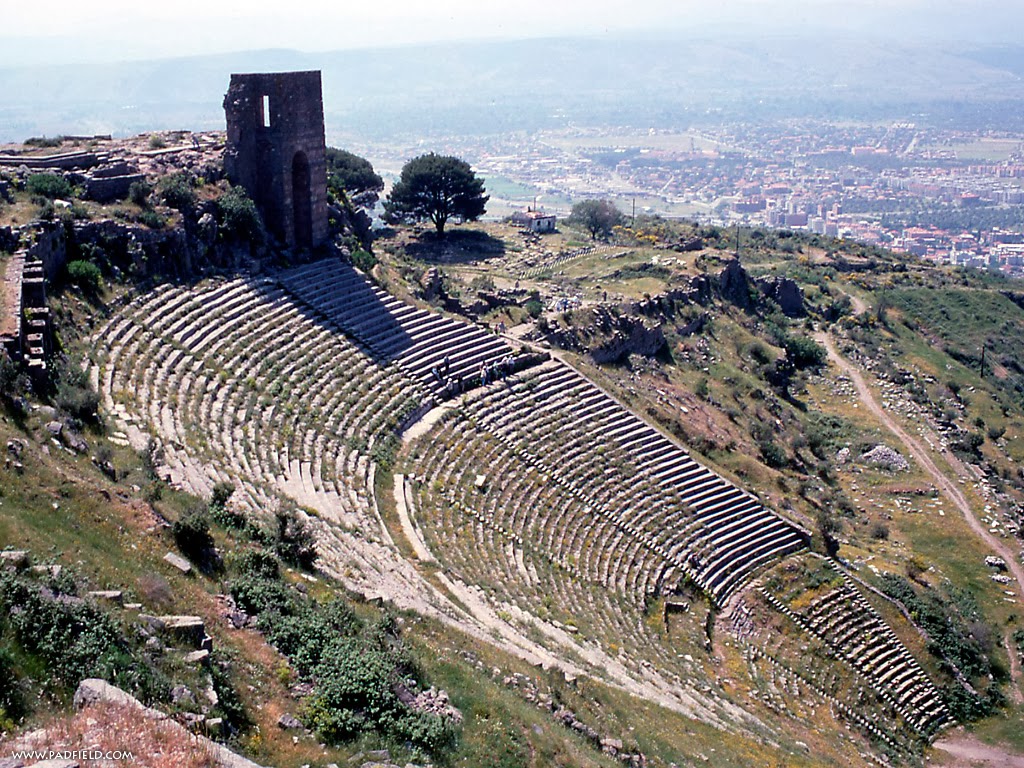
The revelations of Jesus Christ as our God, not just our human companion who walked among us began in this book John wrote with a powerful description of Christ walking amidst the candlesticks that represent His church.  As the messages are conveyed, a particular aspect of that original description is revealed as being relevant to the church who He has a message for.  In this case, it was to the third church on the list of seven, entitled Pergamos.  Historically the city of Pergamum located in Asia Minor or what is now modern day Turkey was renowned for its temples of worship to Greek and Roman deities.  It is said to have built a hospital run by priests who allowed snakes to slither over you at night in order to gain the divine blessing of healing.  It also is reported to have had a great bronze altar constructed for human sacrifice to the Greek god Zeus, where its victims were tied and placed inside, and slowly roasted to death with a fire built under the belly of the bronze bull.  In short, this was not a city known for tolerance, dissent, or the worship of the true God.  And yet, a church took root in this place, and grew to the point of membership in the seven that Christ would relay His messages to.
John relays the message of Christ to this church beginning in chapter 2 and verse 12 saying … “And to the angel of the church in Pergamos write; These things saith he which hath the sharp sword with two edges;”  You will recall the sharp two-edged sword proceeded from mouth of Christ in that earlier passage.  It is and remains the words of Christ that has the power to cleave us from our slavery to selfishness, or see us cut away from the presence of our God.  Our following of Christ, our submission to Christ, in order that we may be remade by Christ, is the basis of our salvation.  The law, and the prophets, and even the scriptures, without Christ are meaningless.  This was a truth that saw the Pharisees relinquish their claim on the true religion of our God, and the Christian church rise up in its place.  What was once His church was cut away by a refusal to embrace Christ, and what had now arisen needed to be cleaved of self by that symbolic two-edged sword.
John continues in verse 13 saying … “I know thy works, and where thou dwellest, even where Satan's seat is: and thou holdest fast my name, and hast not denied my faith, even in those days wherein Antipas was my faithful martyr, who was slain among you, where Satan dwelleth.”  Jesus begins by once again stating He is fully aware of the status of the church at Pergamos.  He knows how His Holy Spirit has been poured out there and what works have been done as a result.  In this case it is the strength of the faith of these people, despite their location and even despite persecution.  Jesus makes 2 references to this city as being where the seat of Satan is, and where Satan dwells.  One could interpret this as being a reference to the altar or throne of Zeus as being the seat of Satan where he is master of the house, and obviously comfortable living there.  The practice of human sacrifice alone is the height of Satan’s religion as he takes from God the thing most precious to God.  Children being sacrificed represent even more of a triumph for Satan, as they are more innocent having had less time to embrace the choices of self-slavery that lead to more ripples of pain.  So the literal ideas of this kind of practice being where Satan is seated is certainly a valid interpretation.  However, it may miss the deeper picture.
The seat of Satan is not constrained to an ancient bronze bull where humanity was sacrificed.  It may also lie in our hearts, where we refuse to yield our human control over to a Savior who longs to free us from the pain and death we embrace.  The place where Satan is comfortable to dwell is not only constrained to a temple built for a pagan god, but is a temple of our bodies that we have customized by a history of self-indulgence where service to self is the highest form of religion and most deeply learned behavior.  We can no more tear down our worship of self, than the stones could remove themselves from the old temple of Zeus.  Both places must be torn down by an outside force.  It is Christ who can tear down our internal altars to self, and remake our bodies as temples of service to others instead of repositories of slavery to self.  It is in our submission to His words and teachings and example of pure love to others we find relief from the pain of our chosen existence.  The lesson here is that even though the surroundings might be considered the heart of darkness and evil, even there salvation from Christ can be found.  It is not our surroundings that determine our proximity to God, it is our willingness to be His, and submit ourselves to Him.  It does not matter where we submit to God, only that we do.
There was one of note, who did just this.  Though little is known from history about the martyr to the faith mentioned as Antipas (obviously not Herod), what is clear from this reference by Christ is that Antipas valued his Christ more than his life.  Tradition or speculation might allow us to believe Antipas died inside that bronze altar, broiled alive for his refusal to sacrifice first to the Roman Emperor before resuming his normal preferred style of worship.  Or perhaps, there was a conspiracy to have him eliminated by the priests who ran the snake hospital, when merely the words of Christ and his healing power were freely given to those in need in that place.  The contrast of healing freely given by the followers of Christ, and the means required and filthy practices of the priests of snakes would have been abundantly clear to the people in need.  In any case, Antipas was killed, because he would not add to his claims of belief an acknowledgement of other gods besides the only true God Jesus Christ.  Antipas would not lie to save his own life, nor would he engage in common practices to shield his true beliefs and allow him to continue to witness and work the ministry for the community.  Instead Antipas thought it a better witness to live in the truth of Jesus Christ alone, and forego his human life in the clear faith of what would be a later life with Christ.  Notice too, Jesus does not declare that since Antipas died, that he is now with Him in paradise.  It was not an instant reward Antipas received, he would sleep until the return of the Lord, but he would once again know the joy of reunion with the Christ he was willing to die for.
The outpouring of the Holy Spirit in the church of Pergamos had clearly resulted in the strengthening of the faith, and the clinging to the name of Christ.  However the message was not all one of encouragement, but also a challenge of what lay ahead.  John continues in verse 14 … “But I have a few things against thee, because thou hast there them that hold the doctrine of Balaam, who taught Balac to cast a stumblingblock before the children of Israel, to eat things sacrificed unto idols, and to commit fornication.”  Within the church, not just outside of it, a section of its members had embraced the idea that freedom was intended for them to be free to gratify self, no longer restricted by the tenets of the law or Jewish traditions.  These members believed forgiveness was granted ahead of their sin, and that restriction itself was no longer binding.  Satan was up to his old tricks, and was sticking with what works.  Balaam had counseled Balak of old to destroy Israel from within, by enticing them with prostitutes and temple feasts of food dedicated to idols.  The symbolic eating of this food, drinking of this wine, and engaging in gluttony and promiscuity had succeeded in drawing the Israelites away from the worship of the true God.  The strategy was once again at work, this time within the Christian faith at Pergamos.  Notice it was not adultery named in this warning, but rather fornication.
Those members as yet unmarried in Pergamos held to the idea that since they were still unwed, they could have intimate relations of a sexual nature with anyone they pleased.  The law itself does not address pre-marital sex after all, it only addresses marital fidelity once the commitment is made.  And both Peter and Paul had revelations that we were no longer bound to the traditions of dietary purity as determined in living a Kosher lifestyle.  However, the counsel of God on our dietary habits was noted as early as the distinction in the number of animals that entered the ark of Noah, 7 clean, only 2 unclean.  Gluttony was more the problem, as both it and promiscuity, reveal a slavery to self that results from a heart that has not yet submitted the things most precious to it, to Christ.  We fear the removal of cherished sins from our lives by the reforming power of Christ.  This is because we do not see the damage these cherished sins are causing us and our victims.  We destroy our own self-worth and kill it in others as we treat what should be sacrosanct as common place.  Thus intimacy is destroyed, and replaced only with an insatiable need for self-gratification.  Our sexual experience is warped to one of self-service, not service to the one we love.  Our diet is gratified any cost, and our bodies suffer from our indulgence and lack of better choices.
This phenomenon was within the church of Pergamos in that day, as it is in our own.  How often we reason that sexual fidelity is only needed after marriage.  How often we reason that what we eat and drink does not matter anymore.  And how often we bear the consequences of the pain we embrace in our choices, sometimes blaming God later for the diseases our choices have resulted in.  In our quest for self-gratification we live lives of mediocrity instead of lives of excellence.  We have relationships that are at best mundane instead of marriages that bring a sense of fulfillment and purpose no one could ever take away.  Our potential to live a real life is denied by our stubborn refusal to let go the chains that are binding us to our pain.  But as we give ALL of ourselves to Christ, what is removed from our lives is the deception of living “good enough” and an awakening to a life of infinite potential.  Our relationships can be founded on what it means to truly love another and in so doing we begin to see each other as God sees us.  We begin to value each other as God values us.  And our lives become real lives, not merely an existence that hardly matters.  We, like the member of Pergamos, need to hear the message of Christ and abandon the deception of self-indulgence.
John continues in verse 15 … “So hast thou also them that hold the doctrine of the Nicolaitans, which thing I hate.”  Again notice, Christ does not hate the people referred to as the Nicolaitans, but only their doctrines and beliefs and deeds as noted earlier.  The chief doctrine of the Nicolaitans which had already invaded the church at Pergamos and our own, was not dissimilar of that of Balaam; a perversion of our freedom into freedom TO sin, instead of freedom FROM sin.  In the case of the Nicolaitans in this instance it extends sexual promiscuity not only before marriage but after it.  Consent from a partner to allow sexual exploration outside of marriage does not constitute consent from God.  The two-edged sword of His word reveals that monogamy is not outdated by “modern” thinking.  It is instead insurance to preserve intimacy between 2 people in order that they may truly “know” each other, serve each other, and uplift and strengthen each other as dates all the way back to Adam and Eve.  We are better as a combined unit, than we are alone.  We complement each other, and help strengthen each other in the Lord.  But when we forsake the unity we find in monogamy, we find ourselves alone, and thus weakened against what the enemy places in front of us.  Marriage itself is not a defense against our enemy, but a faithful marriage based in Christ, founded in submission to Him, can provide a strong deterrent to the evils we would have encountered alone.  It is why Adam and Eve were counseled even in perfection to remain together, a truth no less meaningful for us today.  And a truth forsaken by those who embraced the ideas of cheap grace of the Nicolaitans who preferred pre-ordained forgiveness over reform and an abandonment of the pain of self-slavery.
John continues in verse 16 … “Repent; or else I will come unto thee quickly, and will fight against them with the sword of my mouth.”  The warning to both of these groups within the church, is to repent.  The first and foremost priority of our Lord, is ALWAYS our redemption.  It is not condemnation that is presented first, but instead always redemption.  Condemnation is what we bring upon ourselves when we refuse the course of redemption.  It is automatic, it is the default of a lack of action, or refusal to embrace redemption.  The people who embrace these ideas are warned and counseled to repent in order to find redemption.  If they do not, Christ does not abandon them, but does come quickly and fight against them with the words and sword of His mouth.  Those who finally and fully refuse redemption will be cut away from the presence of our God.  This is not His preferred course of action, but it is not one He will refuse to take.  Those who will not abandon the ideas of placing self first through submission to Christ, will find themselves cut away from the body of His church.  The two ideas of God are in a conflict we cannot win.  If we place self first, we find Christ last, and eventually do not even want Him around at all.  But if we repent and submit to Christ, He can remake how we think, and what we want, and thus what we do.  Christ remains there for us.  He awaits our repentance, and thus our invitation for Him to remake our lives and free us from our chains to self.  There can be only one God, it is not us, it is Christ.
John concludes this message of Christ to Pergamos and us in verse 17 … “He that hath an ear, let him hear what the Spirit saith unto the churches; To him that overcometh will I give to eat of the hidden manna, and will give him a white stone, and in the stone a new name written, which no man knoweth saving he that receiveth it.”  Here the Holy Spirit joins His promise to we who listen to the word of Christ to His church, or to us.  What must be overcome again is our propensity to serve self, exhibited in our gluttony and disregard for the results of eating and drinking whatever we want.  We must overcome our propensity to desire sexual gratification before or after marriage as degenerating only to self-gratification instead of service to only one other.  And these ideas can only be overcome thru repentance to Christ, and full submission of our diet, and of our sexuality to Him alone.  When we do this, we are promised “hidden manna”.  We are promised food that originates in heaven and is provided to us as we have need.  Remember that manna could not be stored any longer than the day it was needed, except on Sabbath.  “Hidden”, means it may not be immediately seen as to where it comes from, but the only source of Manna was always and remains only heaven, from the provision of our Lord.  In effect, He tells us we need not worry about starvation, we are intended for far more than that.
But the promise does not end with merely an assurance that our temporal physical needs will be met.  As is always the case of gifts from our Lord, He has so much more for us than just that.  Here He reveals that our identity itself is to be a gift from Him.  A “new name” is to be chosen and written in white stone (purity) and “given” (not earned), to we who know what it means to be remade by Christ.  Even our names, or how we are known, is to be changed and made pure by Christ.  Our very identity is to be made new.  This revelation of who we are is to be shared only to each of us by Christ Himself.  It is not something others will know, only us.  This reminds us, that intimacy is not just something that originates or is intended in a marriage.  It is something that Christ wants with each of us.  Intimacy is important because it starts first between us and God.  Only then can we begin to experience what it means with another.  Intimacy requires commitment, and a personal one-on-one focus between ourselves and in this case God.  It is through this close and intimate bond that Jesus picks our new name, and reveals it written in a white stone, only to us.  That is how close our God wishes to be with us.  He wishes to know us in a way that no one else can.  He wishes for us to know Him in a way that is unique to us, in effect, a way for us to know Him, like no one else can.
This kind of desired intimacy is not something that is unique to our generation.  But since creation each of us has been so uniquely created that the pattern does not repeat or have a duplicate in all of time or space.  This is the level of personal intimacy God has with each of us, as He has made each of us that level of unique and special to Him.  Our God is not looking for group think, and group values, and group praise – instead He is looking for a deeply personal, deeply intimate relationship with each and every one of us.  We praise Him in secret and He values and accepts our gratitude.  He needs no public display of what is in our hearts, but rather values what our hearts truly offer.  Antipas knew that intimacy and was willing to die rather than see it corrupted.  The destruction of intimacy through promiscuity was not only intended to ruin our relationships here on this earth, it was intended to ruin intimacy between us and our God.  Monogamy was not meant to be a restriction, it was meant to be the ultimate revelation of how personal we are to our God.  It is a recognition of our uniqueness and His desire to be intimate with each of us.  Monogamy in our earthly relationship can be a reflection of the intimacy we share with God, directed at each other.  And thus through submission to Christ, our marriages can become something way more than they are today.  They can become a source of strength, service, and fulfillment that no one could ever take away.  In this message to Pergamos, is revealed how Christ values His intimacy with us, and how a unit of 3, is so much better than the solitude of one.
And the messages were not over yet …
 

Friday, September 6, 2013

Aftermath ...

The darkness remained.  The noise dissipated.  Satan could not believe his own eyes.  He always thought that at some point, Christ in the embodiment of weakened human nature, would find a way to back out of going through with His own death.  Surely God the Father would not permit His most treasured object of affection, to actually die.  Particularly at the hands of this wicked species, who had the special irony of using God’s own religion against Him.  This was beyond the comprehension of Satan that Christ would go through with it, and that God the Father would allow it.
 
Satan and his band of malcontents had lost a war to this Christ.  They had been kicked out of heaven by this Christ.  They knew He had the power of God, and they knew He could easily stop His own death.  And yet He did not.  Christ submitted His own power, and His own desire for self-preservation, and His own human weakness; for the love He felt for us.  And thus Christ went through with our punishment even unto death.  Having all the power in the universe at His disposal, He used none of it to preserve Himself from suffering our fate, and taking on our well-deserved punishment.  This level of sacrifice, Satan had simply become too degraded to understand.  Seeing that love had no limits; effectively had broken down the purported legitimacy of every argument he had ever made about the character of God, on display to the entire universe.
This loss to the kingdom of Satan was stunning.  Satan had long hoped the misery of mankind over breaking the “laws” of God would somehow inspire the rest of the universe to revolt seeing that God was nothing more than a cruel dictator who took pleasure in the punishment of others.  However, to see that same God, give up everything; to see Him sacrifice His only Son; to see the perfect Son do nothing wrong, but willingly yield up even His own life, to save us from the fate and punishment we deserve stood as a real example of why Satan was wrong.  God did not delight in our punishment, but in our salvation.  And He was willing to die in our stead to prove it.  Satan would make no such gesture.  Satan wanted God dead, but would never be willing to make a similar sacrifice for his own kingdom or cause.  The difference was stark.  The difference was clear.  The character of God had been vindicated to the angelic hosts on both sides of the conflict.  The arguments were over.  The rest of sentient life in the universe could see the contrast of love for others without end, and what happens when love is twisted to only please self.  Satan’s argument had failed.  He had lost.  The contrast of good and evil was decided on that cross.  There was nothing left he could say, and there would be no universal uprising against God.  All Satan would have left now, was to hurt God as much as he could before Satan died.  He would hurt God, but by hurting the thing God loves the most, namely us.
Beyond the unseen realm of universal importance was the aftermath of the death of Christ here in our world.  In perhaps the height of hypocrisy, and self-delusion, the religious leaders who would never be able to remove the stain of the blood of Christ from their guilty hands, attempted to purify themselves, and resume services for the Day of Atonement.  Even while they killed the innocent lamb, the irony of killing the Lamb of God was lost on them.  Even though the symbolism of the blood of the lamb to atone for their misdoings was literally all over their fingertips, they missed the reality of what they had just done to the actual Lamb of God.  Instead they would follow self-proscribed ideas about Sabbath observance.  These same ideas had no founding in the values of God.  It was these ideas that had led to the first conflict with Christ, for Christ had loved and healed someone on Sabbath.  And despite their warnings of Christ not abiding by their own Sabbatical laws and interpretations, He had done it again.  So now, in the aftermath of the death of the Lamb of God, in the year of Jubilee when all property must be returned to its owners, all the slaves must be set free, and on the Day of Atonement itself, the religious leaders went about their traditions uninterrupted by the killing of God’s only Son.
But there was a problem.  Great care was always taken so that only the High Priest, wearing the vestments of his office, could enter the Most Holy place in the temple of God.  No one else was permitted to even look into it, upon pain of death.  The priest actually wore bells around the hem of his garment, and a rope tied to his ankles so that he could be pulled out if the bells stopped making noise in the event of his death.  To enter the presence of God with sin, in an incorrect manner, was to die as sin cannot exist in the presence of God.  It was our sin that separated Christ from His Father, broke His heart, and killed Him in grief.  So while every precaution always had to be taken for this singular annual event, today was markedly different.  The great and heavy multi-layered curtain which separated the Most Holy place of the temple from the Holy place where priests were always about their business was torn by an unseen hand from top to bottom.  Temple worshippers, of which there would never be more than now, some of whom had come to Jerusalem hoping to crown Christ their new Messiah King; could now see the Ark of the Covenant without death.  What is more, the presence of God was NOT to be found in the mercy seat.  Christ in fact, would be at rest in the grave on the Sabbath.
Without the presence of God in the temple, there would be no need for pilgrims to come to Jerusalem any longer to worship.  Without the presence of God in the temple, the control of the priests over the people would be broken.  The worship of God would now reside where it always should have been, in the hearts of men, not in the structures we erect in His name.  It was not as if the priests could cover this truth up.  The curtain was torn in front of witnesses.  It could not be repaired quickly.  And the entire missing presence of God was physically seen by the attending crowds.  The need for further sacrifice of sheep’s blood had lost its meaning.  No more would we need sacrifice to point forward to the death of God in our place.  Instead we would now look backwards at this event.  The sacrificial system had lost its significance.  The directives of God for worship in this regard, had been fulfilled.  They would no longer be required.  And to insure we got that message, the curtain had been torn, and the Mercy seat on the top of the Ark was visibly empty.  The laws of God would transfer their significance from the stone shards within the Ark, to the hearts of believers who would submit to their God and learn to love others.  No longer would the Jewish nation be the preservers of love, for they had given that duty away in the act of killing Christ.  From now on, ALL men would be drawn to the Love that was raised upon that cross.  The mercy seat would find its home in our hearts, as would the love of God, when we like Christ yield our will to the Father in Heaven.
The character of God, and the 10 commandment laws were not broken or done away with by Christ, even in death.  Christ still honored God, and kept His day Holy, resting from His own work of salvation; not taking the name of God in vain; nor dishonoring, nor stealing, nor killing, nor lusting, nor coveting.  In every way, before, during, and after His death, Christ upheld the law that began to define what love is to God and man.  This law was a part of “who” God is, and therefore cannot be abolished without abolishing Love itself.  However, the laws of the temple and its system of worship, the laws of animal sacrifice and atonement; those laws had seen their fulfillment in the life and death of Christ.  They would no longer be relevant, or required.  The annual pilgrimage to Jerusalem, or to any other city of worship, would be something without significance to God.  We would now be able to find God, by seeking Him from within our hearts.  God would no longer be constrained to be only in one place, in one temple, in one city.  He was free to be everywhere with us, through the outpouring of His Holy Spirit.
The universe had been sealed forever.  The worship system of God had changed forever.  And the followers of God became publicly scarce in number.  However, the significance of these events were not lost on all who understood the prophecies and what had just been accomplished.  In the heart of darkness, those who had sought Him in secret now emerged boldly from the shadows.   John records in his gospel in chapter 19 and verse 38 … “And after this Joseph of Arimathaea, being a disciple of Jesus, but secretly for fear of the Jews, besought Pilate that he might take away the body of Jesus: and Pilate gave him leave. He came therefore, and took the body of Jesus.”  Jesus was dead.  Joseph was one of the religious leadership so Pilate had no problems with having someone dispose of the body.  Next would emerge another follower of Christ who had kept his own allegiance quiet until now.  John continues in verse 39 … “And there came also Nicodemus, which at the first came to Jesus by night, and brought a mixture of myrrh and aloes, about an hundred pound weight. [verse 40] Then took they the body of Jesus, and wound it in linen clothes with the spices, as the manner of the Jews is to bury.”  These two men and the attending women would take great care of their Lord after His death.  They would gently clean His body, and perfume it with spices and oils, wrapping it in linens for burial.
The Sabbath was very close, and for convenience there was a garden close by, and a new tomb that had never been used within it.  So John records in verse 41 … “Now in the place where he was crucified there was a garden; and in the garden a new sepulchre, wherein was never man yet laid. [verse 42] There laid they Jesus therefore because of the Jews' preparation day; for the sepulchre was nigh at hand.”  They would place Jesus here, at least for the time being, in order that He might rest and they might all return to Jerusalem for the worship they had grown accustomed to performing.  Perhaps they would join with those who sought shelter in the upper room.  Or perhaps they would bear witness to the first fruits that had emerged from their graves at the death of Christ.  A crop he would take with Him when He ascended to the Father; a harvest of what His sacrifice had enabled.  These long deceased messengers and patriarchs of God, walked the streets of Jerusalem with a singular message about the divinity of Christ; a message that would have a resounding resonance. 
By and large the people were still expecting to see Christ at the ceremonies.  They were anxious to crown Him king.  They were anxious to see the prophecies of the Messiah fulfilled.  They had every hope the Romans would soon be leaving.  But the religious leaders knew that could not be the case.  They knew what they had done.  They began to remember the words of Christ, they understood even before His own disciples did, that He might rise again on the third day.  So they took precautions to insure this could not occur through trickery.  John does not record their request they made of Pilate to place 100 guards at the tomb of Christ.  Pilate must have thought the Jews were completely crazy.  But given the popularity of Christ, there was no sense in seeing a riot break out over the disposition of where Christ was buried.  So he directed guards to place a giant stone in front of the tomb, a stone that required many of his guards to move.  They would place a Roman seal on the stone, so that anyone who dared to break it, would know it was a death sentence for them as well.  Pilate and the Jews who sought him out in this matter, believed they had all the bases covered. 
It would have been unusual for the followers of Christ to try something.  Up to now, they had not demonstrated a wealth of bravery.  Up to now, they had been meek, disappointed, sad, and humiliated.  One of their number had betrayed Christ for 30 pieces of silver, and ultimately hung himself in despair.  Another had denied even knowing who Christ was three times in a single night.  One of them was a notorious doubter.  One of them a former Roman tax collector and hated by his own people for it.  Most of the rest were simple fishermen with little education, and no fighting skills.  They would be outmatched at His grave by 100 seasoned Roman killers.  These followers were perhaps the most disappointed in the chain of events.  They knew Christ to be God, but they also knew He was dead at the hands of the priests and the Romans.  Like Satan, they could not understand how God would allow this.  Like Satan, they had always figured that power was the ultimate goal, and they knew Christ had it in Him to take power anytime He wanted.  Like Judas, they probably all had hoped He would simply exert that power to avoid death.  They would have.  We would have.   Why didn’t he?
The aftermath was a time of miracles, a time of reflection, a time of rest, a time of change, and a time of taking measures of precaution.   But nothing could prevent what was about to occur …
 

Friday, October 1, 2010

Second Coming ...

And just when you thought your life was at the end of its rope … Given the massive scenes of destruction described in Revelations that immediately precede the most anticipated event in history - the second coming of Christ; it is a miracle that anyone is alive and still waiting. From the loss of religious freedoms by well-intentioned moralists, to the coming of Satan as Christ – from the prohibition to follow the Bible, to the demands to worship as one is told, not as one believes – from the plagues that comes from God, and the destruction and demonic possessions that originate from Satan – now finally to the mental agony of knowing your past is laden with sin, but unable to find one in the present to ask forgiveness for: it all comes down to this – Jesus returns.

A small dark cloud appears in the sky about the size of a man’s hand, as it approaches the earth it becomes larger and larger. Scientists will no doubt attribute this event to a world-wide cataclysmic end to our existence. As it approaches it transforms from darkness to light, eventually becoming more brilliant than the sun. I imagine when He is finally near enough that every eye shall see Him, He will be seen large enough to encircle the Globe, surrounded by angels in the clouds around Him. What the wicked will hear as the most ominous sound in human history, the righteous will hear as the most beautiful music they could ever comprehend. The sound of love to one, is the sound of guilt to the other. The sounds of acceptance and belonging to the those who have maintained their allegiance to His word, is the sound of impending doom to those who have rejected it. Our brothers, wives, and children personally engaged in the premeditated act of taking our very lives to extinguish all remaining opposition to the world’s new leader Satan disguised as Christ, will break off from their deeds and realize quickly their error.

Terror begins to fill the hearts of those who have sworn their allegiance to the imposter Christ. They realize they are deceived, and even more realize their own willingness to participate in the deception. Those who presumed they had control over the lives and fates, and believed that nothing could touch them now, find themselves vulnerable in the presence of true power. They like Adam and Eve in the garden, feel exposed, naked, unable to mask their wickedness. And “self” cries out to hide from the expositor of its evil nature. They begin to think better to die, than to face the picture of infinite love with a heart that is devoid of all love. Great regret fills their minds, as they realize all the times that love reached out to them, and they refused it. Their unyielding addiction to self overwhelms them, and they begin to seek suicide as their answer, crying for the rocks and debris to fall on them and hide them from the light of love.

But as afraid as the wicked are, there are a few Charlatans who believe despite their recent past, and compromises with evil to stay alive, they will be forgiven and join with those who have remained faithful unto death. They approach Christ, and ask Him, why they are not ascending to greet Him in the clouds, for they have waited a long time too. And He reveals to them the emptiness of their words as He says … “Depart from me, for I know you not.” Their religious actions were as upright as any human eye could determine. They cast out demons, healed the sick, preached to the masses – and yet never had a true conversion of the heart. They never learned how to love, or what love means. For despite their outward appearances, they did not visit those in prison (the guilty). They felt no kinship with the homeless (the poor, and sometimes mentally ill). They had no sympathy on the sick when the cameras and lights were not around. In short, they were able to walk by every need – unaffected. If this is you today, you should ask Christ to change your heart so that you see “need” as He sees it; so that in this great and mighty day, you will not be a part of this crowd.

So many profess Christ in our world today, but do not allow Him to truly change who they are. They do not let Him root out the self-addiction we all suffer from, and as such are blind to the needs all around us. Without true change the heart does not break for the condition of our fellow man, it hardens against them. Without true reform, we are unmoved at the plight of others, and completely subsumed with our own fates. The mark of a Christian is the tear stains on his cheeks as he listens to the pain of his brother. The mark of a Christian is far from the 666 branded in the evil doers, but is the smile he offers when helping another’s needs even at the expense of his own. The mark of a Christian is the heart of Christ embedded within him. It is unnatural for humans to become like Christ, it takes an active action of Christ on our hearts and minds to become as He is. We must ask for it. We must allow it. Or we will never know the joy or the power of it in our lives today or in heaven.

We watch amazed from our positions around the globe, as He calls all the righteous dead to resurrection. There are no disembodied souls accompanying Him on His triumphant return to earth to claim His family and servants. There are angels with Him. There are those first fruits He took with Him from His first trip to earth when we arose on the third day. There is Enoch, who was the first human to so totally submit his own will to Christ, that he literally left earth to walk heavens streets since before the flood. There too is Elisha who was carried away on a chariot of fire. Moses who was called from the earth since long ago. These men and women were real humans, who lived real human lives, and some died real human deaths. But they were all invited to heaven before the main harvest, as a sampling of first fruits to present to God. But now is the time for the main harvesting of the world.

The remaining dead come forth from the last place on earth they died or were buried. They come forth from death, nowhere near as they went into it. They come renewed, recreated in perfection, back to the image their creator intended, fully restored in body, mind, and heart. They are the perfect age, perfect height, perfect weight. They can see for miles with their transformed eyes, and hear a pin drop at the edge of the galaxy with their renewed ears. Their hearts are beating rapidly as their king who they gave their last ounce of courage for has called them back into existence. Death, like sleep, has passed many years as if only a second. Their minds were just seconds ago occupied on their imminent demise and now are fully engaged at the spectacle of their ascension in to the clouds to be with their King. They have no knowledge of what has taken place since they died, nor how long it has been. It is as if their lives have never been interrupted by death, only a momentary pause, and then the scenery changed dramatically.

Now perfected in His image, their hearts, minds, and bodies are free from all traces of sin. They have no natural inclinations to do evil, or serve self. Those things have been finally, and fully eradicated from their existence. They are inclined to love. They are inclined to serve. And now, as the realization of what is happening to them comes fully to mind they turn and ask their accompanying guardian angels, where their loved ones are. I hope the answers do not break their hearts once again.

How merciful our God to allow the dead to sleep untouched by woe in our world that continues after they leave it. Those who believe the dead in Christ, never really die, have no concept of what it would be like to be perfect mind, heart, and soul, and watch the sin and evil of your loved ones be repeated again and again and again. No Saint, should even have to be exposed to the true nature of evil in those they care about around them. The revelation of true character would break their hearts over and over and over again. It is the mercy of God, to allow the dead to sleep without dreams of consciousness of any kind. When finally awakened in the great day of His coming, their lives will forever focus forward on the positive things around them, no more to contend with the burden of sin.

But on this day, death itself must yield up its harvest to our King. Adam and Eve arise, and every faithful servant of God since them to us who have fallen, wake up. They are caught up first says the scripture, then we which are alive and remain (Thessalonians 4:16). Finally it is our turn, our angels are revealed to us as in the twinkling of an eye (or perhaps better worded the blink of an eye), we too are transformed into the perfection God intended for us. Like the dead who have been raised, we are still unique, still distinctive, and still recognizable to those who knew us – but perfection is a long way from what we are today. The blemishes in our skin are gone, the discolorations in our hair gone, the cowlicks, the scraggly beards, the imperfect muscles, the over-abundance of fat cells, the imperfections in our senses, and perhaps most importantly – our minds are freed from the effects of sin both inherited and indulged in our lifetimes. We are truly, and finally free.

This alone, the final and full freedom from sin and all of its effects, and inclinations makes this day the greatest in the existence of mankind short the days that enabled it. Only the life of Christ in our world could mean more to us than the day of our freedom, for without His life, our day of freedom would never be. The Bible will have finally reached its fulfillment as reconciliation with God the Father, God the Son, and God the Holy Spirit will have been achieved. No more prisoner to self, or bound to serve it, we can walk into the throne room and bow and speak directly to the God of the Universe. This is beyond the imaginations of men. It is asking an ant to describe nuclear fusion in a common language, our minds like those of the ant, have been limited by our sinful condition so long, that in the present world there are no words to describe the meaning it will have to be face to face with God without fear, with only love.

Time itself is put on life support. As a concept, time will lose much significance when facing eternity with God. But there is still some events that take place in the measure of time. A prophet once wrote we would not immediately return to the city that same day. It would take as much as a week to get there. I imagine during this week, families will reunite. Lessons will be given to us about the remainder of the Universe, how it functions, how to travel it at the speed of thought. I imagine our work will be laid out in front of us as for the coming 1000 years we have a new duty to perform. I imagine there will be so much joy and information than even now, our feeble minds cannot begin to comprehend it all. But it will be.

Back on earth, the ascensions of both living and dead righteous complete. There remain a few tasks to complete. There were a small group of people who were raised at the second coming of Christ to witness it first-hand. These were not a privileged few, rather a cursed few. They were the priests who killed our Lord on His first trip here. They were raised to see His words fulfilled with their own eyes. And their lament was loud, and formidable. As with all the wicked who were seeking death, the final plague of hail in the fifty pound variety begins to fall and they are granted the deaths they seek. Accompanied with the first world-wide earthquake plus 10 on the Richter scale, islands moved out of the sea, coastlines fall into it. In short, nothing survives this final global ending event except Satan. The world will lie dormant and destroyed completely for the next 1000 years. Satan will be bound here for a 1000 year “time-out”. He will be alone with no-one to tempt chained to the desolation he is responsible for.

But for those who have experienced the transforming power of Christ on our lives; for those who have remained steadfast to His word and have not yielded or compromised with evil for the sake of preservation of their earthly existence – this will be the day we have waited long for. This will be the final end to our earthly existence. From this point forward, our nature, our bodies, and our very lives will return to the perfection God intended. From this point forward, our point of view, will be radically altered. But there is more still to come …